Robot vacuums have been quickly becoming the standard for smart home products, thanks to the advancement in electronics and communication technologies and the maturity of supply chain. However, the cons of robot vacuums exist in an irresistible way. Some bots can’t find their way back to the charging base to recharge itself due to the crummy mapping and path planning. It turns out you have to manually put it back to the base yourself. Your robots might barely detect socks, charging cables and other commonly seen items on your floor, and they often get stuck by such household items - making you feel like they are not actually helping but causing so much troubles - due to a shaky obstacle avoidance feature.
Although most of the times your robots get the job done in one go, they have a slightly frustrating tendency to get stuck whenever they bump into something in their way and you, in turn, have to rescue them. You must be wondering why this keeps happening, even if it's beneath just a piece of furniture, on a thicker rug, or over a threshold at a bathroom door. In fact, experiencing visibility issues and other issues depending on their sensors and algorithms can cause a robot to get stuck or crash into objects.
Obstacle avoidance methods
Technology advances at a rapid pace, and robot vacuum obstacle avoidance technology is no exception. 3D structured light obstacle avoidance, 3D ToF (Time of Flight) obstacle avoidance, monocular or binocular vision based obstacle avoidance, and LiDAR obstacle avoidance are the examples of cutting-edge technology in use today on robot vacuums. These different methods overall create convenience through algorithms and machine learning, and make robot vacuums work for humans like a human.

Obstacle avoidance methods for robot vacuums
3D structured light obstacle avoidance
3D structured light is an active optical ranging solution made up of two parts: the transmitting and receiving ends. Its basic idea is to use an infrared light source and project the emitted light onto the object. When these patterns are reflected back from the surface of the object, different deformations occur with different distances of the object, and the image sensor captures the deformed patterns to know the surroundings around by an image sensor. Face ID unlocking our phone is a great example. Whenever you glance at your iPhone , the TrueDepth camera system will detect your face with a flood illuminator without requiring you to manually enter your password. However, the light spot pattern affects the range of the structured light solution, and the obstacle avoidance range will be limited. Under bright light, the performance may seem poor, and will be easily impacted by light.
3D ToF (Time of Flight) obstacle avoidance
ToF technology itself is a distance measurement implementation. To measure the distance to an object in the scene, the infrared light of the ToF module emits high-frequency light pulses to the object. After the light is emitted, it reaches the object and is reflected back to the sensor of the ToF module. The "time of flight of the light" is calculated during this period. It’s commonly used in AR/VR devices. Take Oculus as an example. 3D ToF can generate real-time 3D point clouds in AR/VR devices, allowing AR/VR software to recognize the surrounding surroundings of any object of interest in the scene more accurately. It can also work in strong or dim light environment, not being affected by the surrounding light. However, the disadvantage of 3D ToF is more fatal to robot vacuums, as low resolution and image information are not helping much in obstacle avoidance.
Monocular & binocular vision based obstacle avoidance
Of various vision-based approaches, monocular vision-based approaches are most suitable for robot vacuums with different reasons such as light weight and short processing time, while binocular vision is more advanced than the former one, being able to make robot vacuums avoid unrecognized objects and capturing depth-of-field information about the objects.
It's common to see robot vacuums are monocularly vision-based. They are equipped with a single camera and identify objects, yet the robot vacuums with a camera raise some obvious security concerns like getting hacked and used to spy on you in your own home, making you feel extremely uncomfortable with such “spy” and it turns out they would no longer be turned on and used due to the risk of privacy leakage.
When binocular vision tech comes to robot vacuum cleaners - whether it is day or night - the robot vacuums will have more significant improvement in obstacle avoidance and extrication than monocular vision. However, they may not be cost-effective. They mostly cost around $1000 which is 100% higher than most of the robot vacuums using LiDAR.
LiDAR obstacle avoidance
LiDAR measures the time it takes for the laser pulse to travel from its location on an object to another object or surface. The time is used to calculate distance, which can be converted into elevation.
The strength of LiDAR is its capacity to help clean more efficiently while navigating. Those robots rely on the classic bump-and-move navigation method, in which bump sensors around a robot are activated, causing it to shift ever so slightly to the left or right in an attempt to navigate around obstacles. LiDAR-based robot vacuum cleaners do not waste time, as their LiDAR system assists it in cleaning efficiently by travelling in lines along with corners and edges. LiDAR is also used in industrial use. In the field of renewable energy , LiDAR can be used to detect basic requirements for solar energy harvesting, such as optimal panel placement. It's also used to calculate wind speed and direction so that wind farm operators can build and install turbines in terms of the data.
The accuracy, speed, anti-interference ability and effective range of laser obstacle avoidance and detection are significantly better than the infrared and ultrasonic ones. It's no doubt that this, as applied to robot vacuums, is the main solution among robot vacuums.
How does LiDAR work with AIRROBO T10+?
When LiDAR-enabled robot vacuum T10+ comes to navigating and cleaning your home, it’s just like a mini “self-driving car” with routes automatically generated through AI before heading to every edge of your house. AIRROBO T10+ empowered with LiDAR navigation scans the surroundings of homes accurately, swiftly, and comprehensively, including chair legs, dustbins, toys, pets, socket extensions, wires, electric fans, books, yoga mats and so on. Every second, the laser sensor on top of T10+ spins 6 times and measures 2160 different points in the room to build a map in 8 meter of radius which is centimeter-accurate, in order to better build up a map of your home, navigate better through sensors and go cleaning along the way.
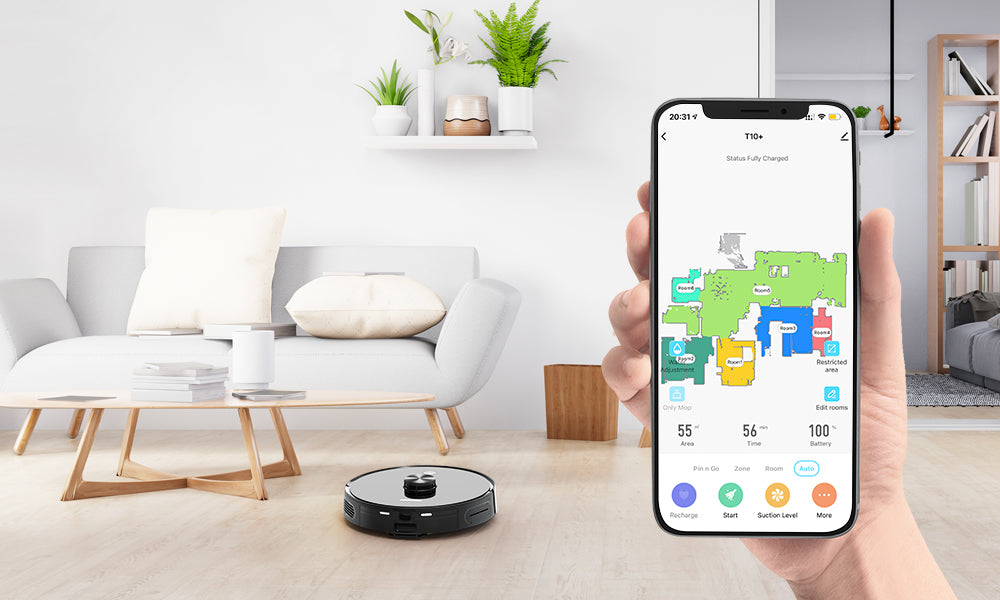
AIRROBO T10+ navigating, mapping and cleaning
USLAM Air 5.0TM navigation algorithm
USLAM Air 5.0TM is transformed from UBTECH Robotics' powerful USLAM technology, which solves real-life problems in household cleaning automation with high efficiency, accuracy and stability.
The upgraded USLAM Air 5.0TM algorithm of T10+ has greatly contributed its efforts to its navigation. It uses lasers to illuminate the spaces and objects that surround the T10+ and map out the distance and the surroundings between the T10+ and them, with the algorithm actively recording the T10+’s surroundings with 23 sets of sensors and 4 sets of cliff sensors. What makes it outstandingly like a human is - USLAM has been proven to be the most robust and reliable algorithm in humanoid robotics industry.
The AIRROBO T10+ is the most convenient and reliable robot vacuum among comparables, making it the perfect choice for modern families. With outstanding cleaning and obstacle avoidance performance, it fits perfectly with most of household scenarios. AIRROBO has never stopped researching and developing ground-breaking artificial intelligence technologies to simplify people’s everyday life, and we are excited to bring you even more great products in the future.